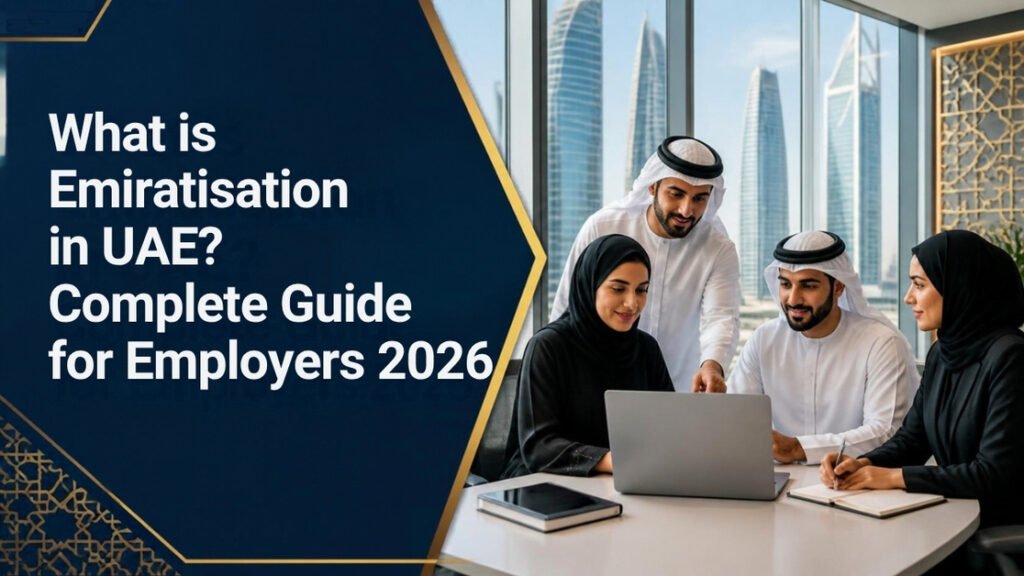
If you run a business in the UAE, you’ve almost certainly heard the term Emiratisation. But what exactly does it mean, why does the government enforce it so aggressively in 2026, and — most importantly — what do you need to do as an employer? This complete guide answers every question.
What is Emiratisation in UAE?
Emiratisation (also spelled Emiratization) is a UAE government initiative that requires private-sector companies to hire a specific percentage of Emirati nationals in their workforce. The policy is enforced by the Ministry of Human Resources and Emiratisation (MOHRE) and is designed to reduce the country’s reliance on expatriate labour and build a sustainable, knowledge-based economy for UAE citizens.
The programme is not new — it was first introduced in the early 2000s — but 2022 marked a turning point when the government dramatically increased mandatory targets and began enforcing heavy financial penalties on non-compliant businesses.
Who Does Emiratisation Apply To?
Emiratisation targets apply to private sector companies with 50 or more employees operating across all sectors. Companies with fewer than 50 employees are generally exempt from the mandatory quota system, though they are encouraged to participate voluntarily.
Key sectors with elevated targets include banking and finance, insurance, retail, hospitality, healthcare, construction, and technology.
What Are the 2026 Emiratisation Targets?
The UAE government set an annual Emiratisation growth target of 2% per year for skilled roles in the private sector. For 2026, companies with 50–99 employees must have at least 1 Emirati employee, while larger companies must meet sector-specific percentage targets. The government reviews these targets annually, and they are expected to increase each year through 2030.
Skilled roles are defined as positions that require a university degree or equivalent qualification, which means the policy focuses on professional, technical, and managerial positions rather than low-skilled labour.
Why Does the UAE Government Enforce Emiratisation?
There are three main drivers behind the UAE’s commitment to Emiratisation:
- Economic diversification: The UAE’s Vision 2031 agenda prioritises moving away from an oil-dependent economy toward a knowledge economy where Emiratis play a central role.
- Youth employment: The number of UAE graduates entering the job market grows every year. Emiratisation creates structured pathways for young nationals to enter the private sector.
- Wage and skills parity: Historically, many Emiratis preferred government jobs for their higher salaries and stability. The government is using Emiratisation incentives and penalties to make private-sector employment more attractive and equitable.
What Are the Benefits of Hiring Emiratis?
Beyond avoiding fines, there are genuine business advantages to building an Emirati workforce:
- Government incentives: MOHRE offers wage subsidies and training support for companies that exceed their Emiratisation targets.
- Brand reputation: Companies that demonstrate a commitment to UAE nationals tend to win government contracts more easily and enjoy stronger relationships with regulatory bodies.
- Local knowledge: Emirati employees bring invaluable cultural insight and Arabic fluency — especially important for businesses serving UAE consumers.
- Tamm and Nafis programmes: Government support schemes provide financial top-ups to Emirati salaries, reducing the effective cost to employers.
How Do You Comply With Emiratisation Requirements?
Compliance involves four key steps:
- Calculate your quota: Log in to the MOHRE portal or the Tasheel platform to see your current headcount, sector classification, and the exact number of Emiratis required.
- Source Emirati candidates: Register on the Nafis platform (powered by MOHRE), attend Emiratisation career fairs, or work with a specialist Emiratisation consultancy in the UAE to identify and screen qualified candidates.
- Onboard and retain: Emiratisation is not just about hiring — MOHRE monitors turnover. Companies that repeatedly hire and then lose Emirati employees face additional scrutiny.
- Report on time: Headcount data must be kept up to date in the MOHRE WPS (Wage Protection System). Delays in registration can trigger non-compliance flags.
What Happens If You Don’t Comply?
Non-compliant companies face monthly fines of AED 9,000 per unfilled Emirati position. For larger organisations with multiple open quota slots, these penalties can reach AED 100,000+ per month. Read our detailed breakdown of Emiratisation fines in UAE 2026 to understand the full financial exposure your business faces.
How Etqaan Can Help With Emiratisation
At Etqaan, we are a specialist Emiratisation consultancy in the UAE with a dedicated talent pool of pre-screened Emirati professionals across finance, HR, engineering, sales, and operations. We help companies across Abu Dhabi and the wider UAE:
- Identify the right Emirati candidates for skilled roles
- Manage the full end-to-end hiring and onboarding process
- Advise on MOHRE compliance, reporting, and penalty avoidance
- Develop long-term Emiratisation workforce strategies
Whether you need to fill one position or build an entire Emiratisation programme, our team is ready to help. Contact Etqaan today for a free consultation.
